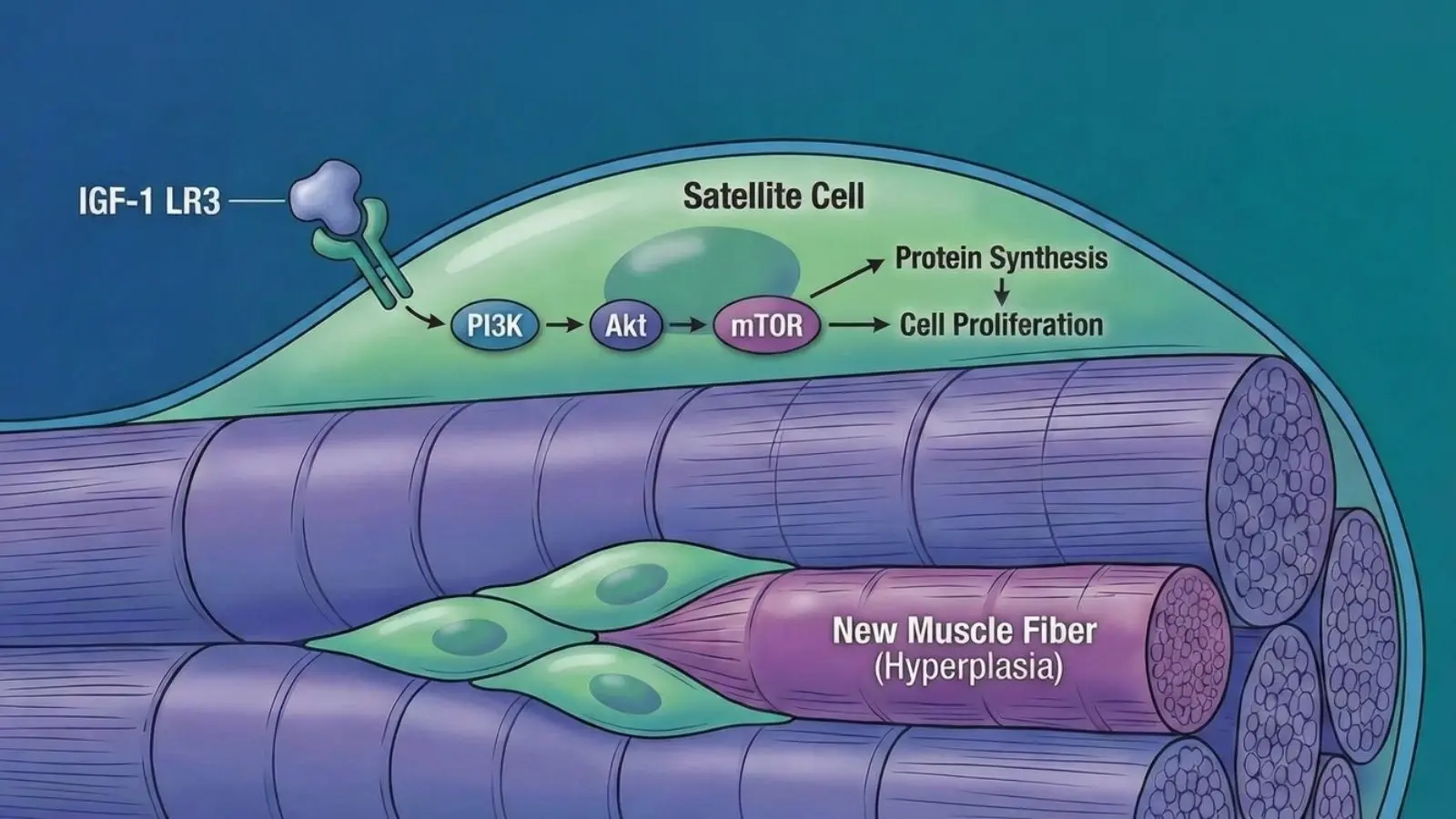
What is IGF-1 LR3?
IGF-1 LR3 (Long R3 IGF-1) is an engineered analogue of human insulin-like growth factor 1: arginine replaces glutamic acid at position 3, plus a 13-residue N-terminal extension, both changes weakening its grip on the binding proteins that normally sequester IGF-1. It is sold strictly as a research chemical, is not approved by the FDA or any other regulator for human use, and nothing here is medical advice.
Its documented use is in the laboratory, as a serum-free supplement for cell culture; the animal work specific to it is largely rat growth studies from the early 1990s. Recombinant native IGF-1 (mecasermin) is an approved medicine for severe primary IGF-1 deficiency, but LR3 is a different molecule with no controlled human trials of its own.
PeptidesFinder's role is narrower than the science. We track which research vendors list IGF-1 LR3, normalise every listing to a price per milligram so vial sizes can be compared, and record whether a recent certificate of analysis is on file. The comparison below is re-checked on a schedule; confirm current pricing on the vendor's own site before ordering.
Where to Buy IGF-1 LR3 Online
182 vendors in our directory currently list IGF-1 LR3 — 169 online stores and 13 wholesale suppliers. Stores sell by the vial with a price you can check; wholesale suppliers quote per gram on enquiry. Featured vendors paid for their placement; ratings and trust signals are never for sale.
The top 15 online stores are compared below, ordered by our directory ranking.
- Verified
- Tested
- COA
- Guarantee
- Reputation score
- Not yet rated
- User reviews
- No user reviews
- Tested
- COA
- Reputation score
- 4.9Rated 4.9 out of 5
- User reviews
- No user reviews
- Tested
- COA
- Reputation score
- 4.7Rated 4.7 out of 5
- User reviews
- No user reviews
- Tested
- COA
- Guarantee
- Reputation score
- 4.7Rated 4.7 out of 5
- User reviews
- No user reviews
- Tested
- COA
- Reputation score
- 4.5Rated 4.5 out of 5
- User reviews
- No user reviews
- Tested
- COA
- Guarantee
- Reputation score
- 4.5Rated 4.5 out of 5
- User reviews
- No user reviews
- COA
- Reputation score
- 4.3Rated 4.3 out of 5
- User reviews
- No user reviews
- Tested
- Reputation score
- 4.3Rated 4.3 out of 5
- User reviews
- No user reviews
- Tested
- COA
- Reputation score
- 4.1Rated 4.1 out of 5
- User reviews
- No user reviews
- Tested
- COA
- Reputation score
- 3.8Rated 3.8 out of 5
- User reviews
- No user reviews
- Reputation score
- 3.7Rated 3.7 out of 5
- User reviews
- No user reviews
- Tested
- COA
- Reputation score
- 3.1Rated 3.1 out of 5
- User reviews
- No user reviews
- Tested
- COA
- Reputation score
- 2.8Rated 2.8 out of 5
- User reviews
- No user reviews
- Reputation score
- Not yet rated
- User reviews
- No user reviews
- Reputation score
- Not yet rated
- User reviews
- No user reviews













| Vendor | Trust signals | Reputation score | User reviews | Coupon | Visit vendor |
|---|---|---|---|---|---|
| Not yet rated | No user reviews | — | Visit site | |
| 4.9Rated 4.9 out of 5 | No user reviews | — | Visit site | |
| 4.7Rated 4.7 out of 5 | No user reviews | — | Visit site | |
| 4.7Rated 4.7 out of 5 | No user reviews | — | Visit site | |
| 4.5Rated 4.5 out of 5 | No user reviews | — | Visit site | |
| 4.5Rated 4.5 out of 5 | No user reviews | — | Visit site | |
| 4.3Rated 4.3 out of 5 | No user reviews | — | Visit site | |
| 4.3Rated 4.3 out of 5 | No user reviews | — | Visit site | |
| 4.1Rated 4.1 out of 5 | No user reviews | — | Visit site | |
| 3.8Rated 3.8 out of 5 | No user reviews | — | Visit site | |
| 3.7Rated 3.7 out of 5 | No user reviews | — | Visit site | ||
| 3.1Rated 3.1 out of 5 | No user reviews | — | Visit site | |
| 2.8Rated 2.8 out of 5 | No user reviews | — | Visit site | |
| Not yet rated | No user reviews | — | Visit site | ||
| Not yet rated | No user reviews | — | Visit site |
Compare all IGF-1 LR3 prices per mg →
Some outbound links are affiliate links: purchases made through them may earn PeptidesFinder a commission at no extra cost to you.
13 wholesale suppliers list IGF-1 LR3 for bulk orders. Quote-based — send an enquiry from the supplier's page and compare MOQ, lead time and COAs. Your enquiry goes to the supplier through PeptidesFinder; their reply lands in your inbox.
Revolution Peptides
Wholesale supplier
PureGenix Peptides
Wholesale supplier
Pep Direct
Wholesale supplier
Fashion Pep
Wholesale supplier
LP Peptide
Wholesale supplier
Aavant Research
Wholesale supplier
Pepix Labs
Wholesale supplier
Sema Peptides
Wholesale supplier
Mechanism of Action
What follows comes from receptor pharmacology, cell-culture work and rodent studies. Where a result was produced with native IGF-1 rather than the LR3 analogue it is said so explicitly, because the two are routinely conflated.
Receptor target. IGF-1 LR3 acts at the type 1 IGF receptor (IGF-1R), a receptor tyrosine kinase; ligand binding drives autophosphorylation of the beta subunits and recruitment of the adaptor proteins IRS-1 and Shc. In binding studies it also engages the insulin receptor and IR/IGF-1R hybrid receptors with lower affinity, which is the usual explanation for the fall in blood glucose observed when IGF-1 analogues are given to laboratory animals.
Escape from the binding proteins. Native IGF-1 circulates almost entirely bound to a family of six IGF binding proteins, which limits how much of it reaches the receptor. The arginine-for-glutamate swap at position 3 and the N-terminal extension both reduce IGFBP affinity, and in the binding and cell-based potency assays reported by Francis and colleagues the analogues that evade IGFBP capture were substantially more potent than native IGF-1 at the same receptor. The difference is attributed to ligand availability, not to a different receptor or a different signal.
Downstream signalling. Activated IGF-1R feeds two well-characterised branches: PI3K-Akt-mTOR, associated in cultured cells with protein synthesis and suppression of apoptosis, and Ras-Raf-MEK-ERK, associated with proliferation. In cultured myoblasts these are the routes by which IGF-1 promotes differentiation and myotube hypertrophy. That is cell-culture pharmacology, not a human finding.
Rodent evidence. The in vivo work specific to this analogue is a cluster of rat studies from the early 1990s, reporting greater weight gain, nitrogen retention and gut and muscle protein accretion than equivalent native IGF-1 in both normally fed and catabolic rats. The endpoints were carcass and nitrogen-balance measurements in rats, and there is no human counterpart to any of it. The frequently cited demonstrations of skeletal-muscle hypertrophy, in IGF-1 transgenic mice and in mouse muscle given IGF-1 by viral delivery, used native IGF-1 and not LR3, so reading them onto this analogue is an inference from shared receptor biology rather than a result about it.
Documented laboratory use. The one setting in which the analogue itself has a reproducible published role is cell culture: LONG R3 IGF-I is used as an insulin or serum substitute in serum-free mammalian production lines, where it has been reported to support the growth and protein productivity of CHO cells. That is a bioprocessing reagent application, and it is what research-grade material is nominally sold for.
None of this establishes safety or efficacy in humans, and the mitogenic, anti-apoptotic character of IGF-1R signalling is itself a reason the compound stays in the laboratory: observational studies have linked higher circulating IGF-1 to the incidence of several cancers, an association in population data rather than a demonstrated effect of this analogue. Recombinant native IGF-1 (mecasermin) is an approved drug for severe primary IGF-1 deficiency, but IGF-1 LR3 is a different, modified molecule, and the research-grade product sold by these vendors is not that approved medicine and is not approved for any medical use.